Monday, 28 February 2022

Hello families,

I hope you are well. It's been another jam-packed week at school, trying to squeeze all the February celebrations in.

Last week, we had Canada's pink shirt day. We heard the story of how this day came to be, and we had a good talk about what bullying is. We focused on the importance of INcluding, not EXcluding and how we can be supportive friends every day at school. We also talked about what a bystander is. I explained that it's, basically, someone who stands by. The people standing by when someone needs help have a choice - they can do nothing, or they can try to help. A good bystander might invite someone who is having trouble to walk away or come play with them. A good bystander might support their friend with words or actions of support (like the students that started pink shirt day). A good bystander would go and get an adult if they see someone is in trouble. We shared examples of when people have helped us in the past, which was really nice, and made pink shirt posters with kind words and reminders.

Pink shirt day ties in well to Black History Month, which we also focused on a lot this week. The kids are already very familiar with the story of Viola Desmond, but we read it again anyway. The kids were quick to point out all the injustices in her story, and question why someone would be treated that way, or why people would be separated, simply because of their skin colour. As with the pink shirt, we talked about how important it is to include everyone, regardless of how we look, what colours we like, or what our favourite activities are. We can see that even within our small class, we all look different. Some students shared that they believe everyone is unique and special in their own way.

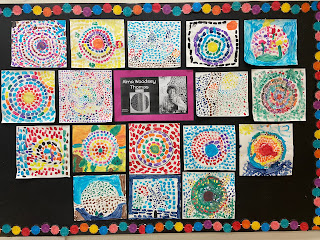
This year, I came across the work of African-American visual artist, Alma Thomas. I did a bit of research about her life that I was able to present to the class. Like Viola, she grew up in the time of segregation, but her family moved from Georgia to Washington, where there were more opportunities. There, she taught art for 30 years before developing her signature artistic style. Inspired by nature and space, she used vivid colours and a brick mosaic, almost puzzle-like style of painting. Many of her works show a circle pattern. This is what many of us tried to recreate in our project. I was very impressed with our class while doing this project. I had anticipated they would follow my instructions and make a circle pattern with colours they liked, which would have been great. But many students had an idea in their mind, as Alma did, and they tried to communicate it in her style. Ask your artist what they had in their mind that they were trying to convey, and what Alma was trying to depict in the examples below. 

In science this week, we started our energy unit by brainstorming a variety of things that move - next we will start sorting them into groups, according to where they get their energy. Ask your scientist to look around your home for things that move or turn on - what's making them move, or run?


In math, we have learned several helpful strategies for adding and subtracting, such as using counters (les jetons) to combine or remove, crossing off items from a picture and learning the number partners that "make 10" faire 10. Some of us do so much practice for this number sense unit at home, that we don't always need these strategies. For other students, I see how helpful they are, so it's definitely worth learning. We will try to apply these strategies, and develop others, through some more complicated problem solving. The mathematicians are really enjoying doing their extra "colour by math" pages once they have completed the task we were working on for the day.

In February, we also had the Olympics going on! I wish we had done more with this. However, we did do our own olympic course for DPA last week. We had to luge down the slide, speed skate across the icy ground, curl a ball towards a target tree (one partner tried to sweep a path clear of snow) and then finish up with a snow angel!


Be well, Tamara

Friday, 18 February 2022

Happy Family Day!

Dear families,

There has been so much to celebrate this month! I hope you enjoy a lovely long weekend and family day with your loved ones. With the PA days, our library day will switch to Tuesdays, and our words of the week will return to Tuesdays as well.

It was really nice speaking with many of you yesterday and today. I have some good goals for myself and our students for next term. One idea that came up was to create a parent contact list that we can share, which will hopefully help facilitate some playdates, when and if your family is ready. I will send home a little form so that you can let me know if and what contact info you would like to share. Of course, it is completely optional. Everyone in our class will receive a copy of the list I compile. Please return the form to me by next Friday.

We had a lovely Valentine's Day this week. We brainstormed some kind messages and had lots of time to work on extra cards, valentines or decorations that we wanted. We sat in groups with our classmates all day, and at the end of the day, we had time to deliver our valentines to each other. I had so much fun designing a recycled crayon heart for everyone! 

This week, we are beginning new units in math and science. In math, we are beginning our unit on operations (addition, subtraction and problem solving). Many of us practice these skills at home and have expressed a lot of enthusiasm already! I've provided many extra fun practice pages for students that wish to do some extra math during lunch or any free time they have, and many students have already begun exploring these activities when they've completed their assigned tasks. This unit isn't just about how high or how quickly we can add. It's also about how we can show our thinking during problem solving. We will share some helpful strategies for this and learn how we can show them in our written work.

In science, our next unit is about energy. We will learn that energy makes things move, and we will look deeper at what is causing the movement - the sources of energy. I have some fun activities planned! Last week, we finished up our unit on structures by viewing a tour of unique world structures, man-made and natural, that I created on Google Earth. It is linked in Google Classroom, so students can view it again if they like. They can also use Google Earth to visit other structures in the world that they are curious about!

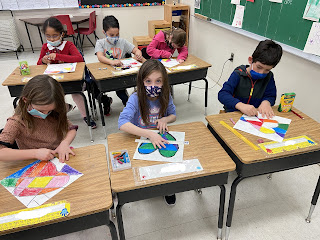
For art this week, we finally did a project we talked about when we were studying symmetry. We used special finger painting paper, which is shiny and doesn't soak up the paint so quickly. We painted only half of our image and then folded it to create the other half of the picture. Many students used my half butterfly or flower template to trace an outline, but everyone created their own beautiful designs within. 

Words of the Week

Like in English, another way to make the ‘k’ sound in French is with ‘q+u’.

Most of the words that begin with ‘qu’ are question words. In English, we think of the 5 W’s (Who, What, When, Where, Why). In French, it’s the 4 Q’s: Qui, Quoi, Quand, Que, Pourquoi (and Où).

When you read stories, take time to discuss them using these words. Who was it about? (Qui), Where and when did it take place? (Où & Quand), What happened? (Quoi/Qu’est-ce que), Why did this event happen? (Pourquoi)

que, qui, quoi, quel, quand, quatre

Bonus words: pourquoi, qu’est-ce que


The sound ‘in’ is very tricky. I remember sitting around the table with my exchange family trying to match exactly what they said so that I might have a nice French accent!

Your expert French speaker needs no assistance speaking this sound, they all know how to say "la fin"! The best way I’ve found to describe it is to start saying the word “kangaroo” but pause on the “an” part. This is approximately the right sound. Note: The last 2 words in the list have a pesky e in between the i and n. We already learned what sound e+n makes, but in this case, they make the ‘in’ sound. We still hear the regular i sound as well. I’m sure you’ve heard the phrase, Très bien!

lapin, la fin, train, vingt, bain, rien*, bien*

Bonus words: cinq, dinde


Be well, Tamara


Tuesday, 8 February 2022

Valentines

Dear parents,

Time seems to be flying by, and it is report card season again. Reports will come home next Wednesday the 16th (I believe) and interviews will take place the evening of Thursday the 17th and the morning of Friday the 18th. You will likely receive information on how to sign up using the online system again. Interviews are not required at this point, but I am always happy to meet with everyone, even if we have no pressing concerns.

On Monday, I sent home the math and writing rubric that I mentioned last week, and I've started teaching our students how to read one. I've told them that if they follow instructions really well and do what has been asked, that's usually a level 3, which is like a B, and is really good. Level 2 means that they were close to understanding how to do something, or they did it with help from me. This is like a C grade, and is something to be proud of. We are learning. Level 4 is like an A, and it means that you did everything that was asked, but also a little bit more. Some examples for us might be, colouring your work in, even if it's not required, or colour coding it to make it easier to read; adding as many shapes as possible to a Venn diagram, not just the minimum; sounding out a longer, more challenging poem; giving more examples, or adding more detail to work. Right away students were interested in knowing how to get a level 4 in the math work we were doing, and started doing the extra challenges I suggested! We will continue talking about how we can show extra effort, even when it comes to learning skills.

Next Monday is also Valentines Day. We will have time during the day to exchange cards. It is completely optional, but if your student would like to prepare cards in advance, please make sure that the whole class is included. Here are our names:

Abigail, Alex, Alfred, Bennett, Callum, Cersei, 

Eliane, Elijah, Elowyn, Finlay, Helena, Isaac, 

Kai, Logan, Milo, Niamh, Rose, Sophia, Theo

This week, we did a beautiful heart art project exploring warm and cool colours. Warm colours inside the heart, and cool colours around it. They are really brightening up our room!


We have been progressing with our recipes. We have all completed our ingredient list, and have started explaining the steps. For this part, students are trying to compose their own sentences, using the ingredient list, our word wall, and some action words that we've brainstormed. It's not easy, but we're getting there. 

Words of the Week

The letter C can make three different sounds in French. On it’s own it can be either soft (‘s’) or hard (‘k’). The vowel that follows can help you decide which it is, but there are always exceptions. In general, a c followed by an e, i, or y is soft. A c followed by a, o, or u is hard. When a c has that funny little thing that looks like a 5 under it (called a cédille) it is always soft. You’ll see in our words with c-cédille that those c’s would normally be hard, but the cédille breaks the rule. This is a lot to remember, so I haven’t shared all this with the kids, they just know that ç makes ‘s’. 

The third sound that c can make, when followed by h, is ‘ch’ - sounds like the English ‘sh’.

ça, garçon, glaçon, le chat, le chien, le cochon

Bonus words: la vache, le cheval


Don't forget to access Google Classroom for at-home work and resources, should you need to be away from school for an extended period. 
Take good care, Tamara