Dear parents,
As you probably know, Report Cards for Term 1 are coming home next Tuesday. I will discuss the report card format with the children at the end of the day and remind them of the same "report card etiquette" that I wrote about in November.
A note is coming home tomorrow explaining how the interview process works at this time - it's a bit different than in November. If you have received my invitation along with this letter, please don't worry, I just want to chat about how things are going and next steps. If there is no personal invitation from me attached to this letter, you can assume that I don't feel any immediate need to meet face-to-face. If you feel that you would like to meet or speak over the phone, please email me and I'll be happy to set it up.
Thanks!
Tamara
Tuesday, 4 February 2014
Monday, 3 February 2014
What materials make a good boot?
More project news!
We are working on a mini science experiment this week. Recently we have been discussing the various structures we have at school and at home, and what they are made of. For instance, we have chairs at home and at school, but at home, they tend to be padded, while at school they are usually plastic with straight backs. The scientists told me that this is because at home we need to relax, while at school we need to focus and we need to be able to wipe up spills easily.
We also talked about the type of shoe we need for gym class, why others won't work as well, and what they are made of. Other good examples were book shelves, that need to be built of strong materials, and pillows that need to be made of soft, squishy materials.With this in mind, students are working in small groups to construct a boot! They have 6 materials to work with: cardboard, wooden sticks, plastic straws, aluminium foil, wax paper and felt. They have to decide which materials will make the best boot (we decided a boot needs to keep our feet dry and warm). Together with their group, each student is drawing a plan that shows how they plan to use the various materials. Many scientist even took samples to test under running water to see if the material would be waterproof.
When our plans are complete, we will build and test our boots. The scientists are very excited about this experiment, as am I. Please ask them what they're planning with their group - what materials are they planning on using, and how?
Talk to you soon!
Watercolours and Still Life
Our words of the week are:
This week we will continue with the sound 'eh' (not 'ay') and learn two more ways of making it. In addition to "ai" and "es", we can also make this sound with both "è" and "ê", and with "-et" when it finishes a word (like un jouet).

 Some words that use these letters are: père, mère, frère, juillet, chère, première, prêt, tête
We had another great workshop with Donnely Friday afternoon. Hopefully you have already heard all about it.
It began with colour mixing using watercolours. We made all of the secondary, and even the tertiary colours, such as blue-violet, and yellow-orange. We also experimented with white, adding it to our other colours to make pastel shades.


Then, we learned a technique called repelling. The watercolour paint repels from the wax in pastels so that you can use both mediums together, and they work beautifully together. Somehow the paint makes the pastels seem brighter.

Donnely explained what Still Life is, and gave us some tips for sketching some lovely flower bouquets. The artists sketched freely with pastel, looking for shapes and adding as much detail as they wanted.


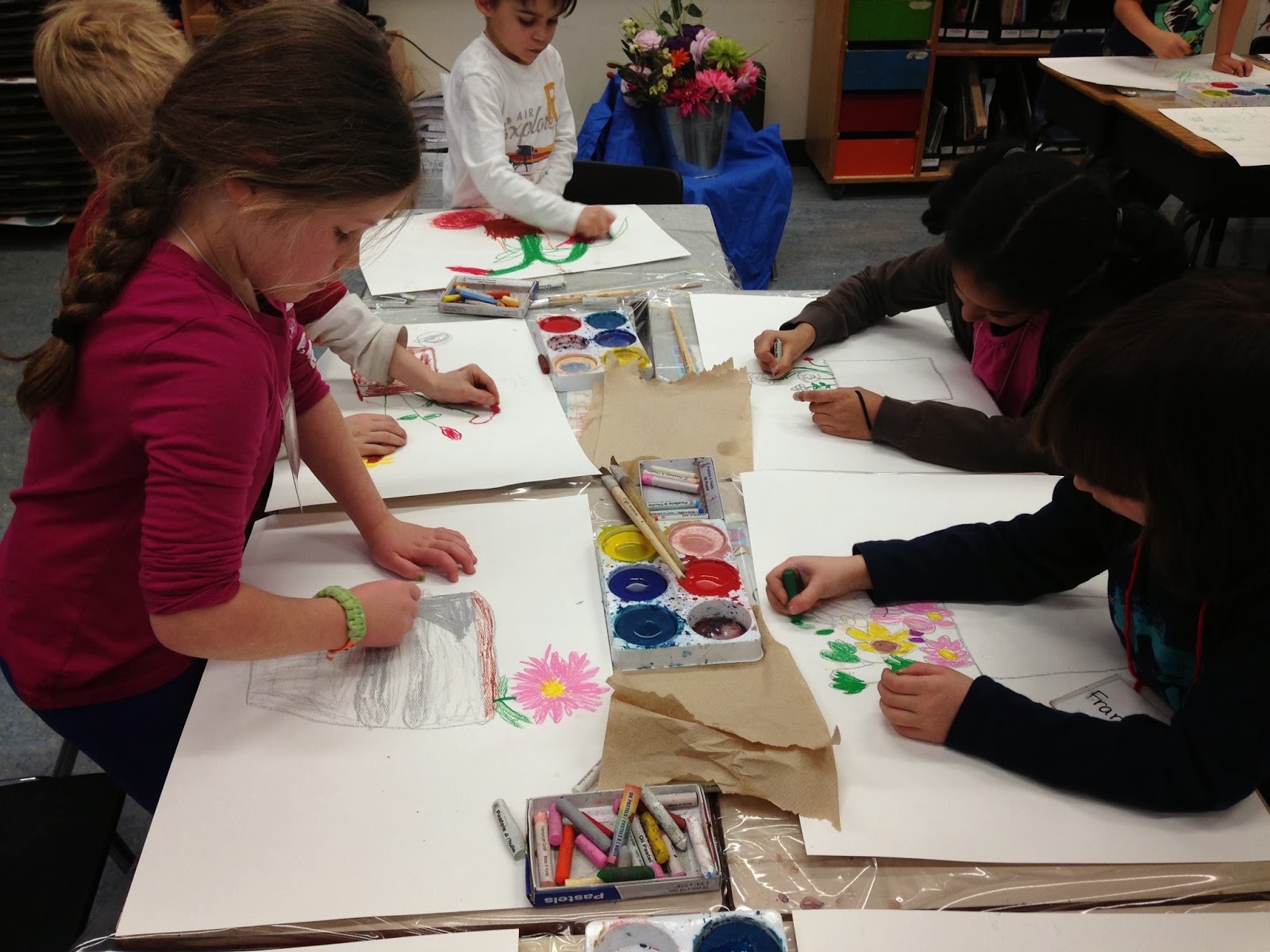

Then, they painted over it with the watercolours and their sketches started popping off the page. They are quite beautiful!


la table, le zoo, un éléphant, le vent, le soleil, la boue, la maison
This week we will continue with the sound 'eh' (not 'ay') and learn two more ways of making it. In addition to "ai" and "es", we can also make this sound with both "è" and "ê", and with "-et" when it finishes a word (like un jouet).
It began with colour mixing using watercolours. We made all of the secondary, and even the tertiary colours, such as blue-violet, and yellow-orange. We also experimented with white, adding it to our other colours to make pastel shades.
Then, we learned a technique called repelling. The watercolour paint repels from the wax in pastels so that you can use both mediums together, and they work beautifully together. Somehow the paint makes the pastels seem brighter.
Subscribe to:
Posts (Atom)